Gamification: What is it and why is it revolutionizing businesses and schools?
Thursday 11 de December 2025 / 12:00
⏱ 3 min read
(Buenos Aires, SoloAzar Exclusive).- This article analyzes the origin of the term gamification and describes how it has become a key strategy to increase motivation, engagement and performance in both school and professional environments.
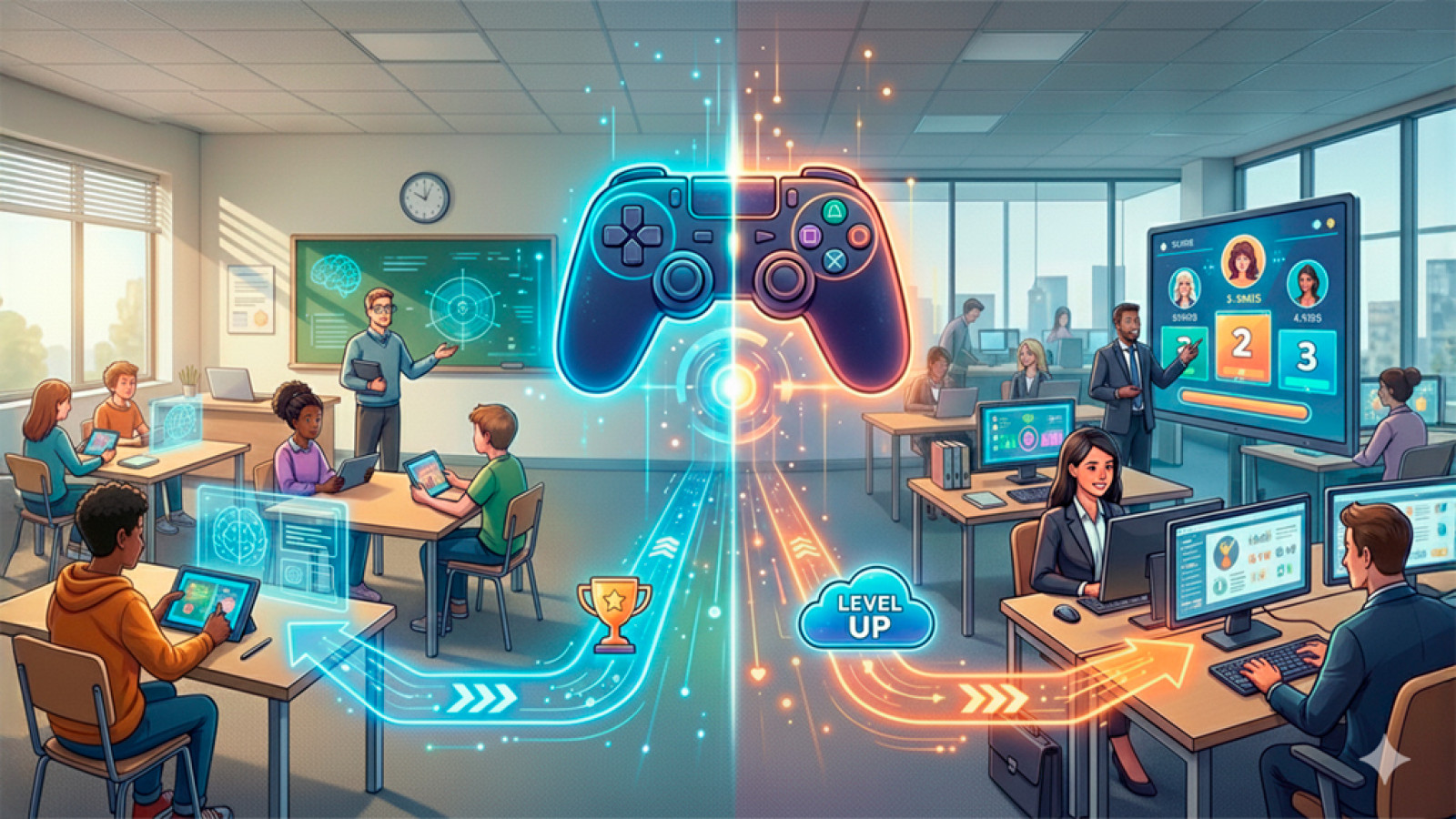
In recent years, the word gamification has been on everyone's lips. Schools, businesses, teachers, and managers alike use it daily. But do we really know what we mean when we talk about gamification?
In short, gamification involves applying game elements to non-game contexts. Its main objective is to motivate behavior , maintain interest, and improve results through more meaningful experiences.
As Central American professors Ana María Villamar Gavilanes and Ricardo Sánchez Casanova explain:“Gamification is not playing, it is using the ingredients of games to develop learning experiences, generate adventures and awaken emotions in students.”
Furthermore, gamification is based on motivation theories, such as self-determination theory, which highlights three psychological needs: competence, autonomy, and relatedness. Therefore, gamified environments tend to enhance these dimensions, increasing participation and a sense of accomplishment.
The origin of Gamification
The renowned Spanish academic Ruth Contreras Spinoza explains in the Educaweb publication that “The concept, defined by Deterding, Dixon, Khaled, and Nacke in the article 'Gamification: Toward a definition' in 2011, refers to the use of game design elements in non-game contexts. In an educational context, gamification has the potential to shape user behavior as a new teaching and learning method, to motivate students, and to foster greater engagement with subjects and their learning.”
Gamification vs. Serious Games
Another important point to clarify is that a common mistake is confusing gamification with the idea of serious games. On this point, Contreras Spinoza sheds light on the matter by highlighting that “ The biggest error is confusing the concept of gamification with serious games. While the latter describes the design of games that don't have the primary objective of entertaining users, 'gamified' experiences or examples simply employ some game elements such as rules, mechanics, etc.”
Applications in school settings
In education, gamification is implemented to improve active learning and content retention. Among its most common uses are:
- Points and reward systems to encourage participation.
- Missions or challenges that replace traditional activities.
- Thematic narratives that connect curricular units.
- Leaderboards that can encourage friendly competition (although they require care to avoid generating anxiety).
- Gamified educational platforms , such as Classcraft or Kahoot, that combine assessment and gameplay.
Studies indicate that gamification can increase intrinsic motivation, although its impact depends on good pedagogical design and avoiding dependence on extrinsic rewards.
Applications in the workplace
In the world of work, gamification is used to:
- Corporate training , through simulations, interactive courses and progression systems.
- Performance management , integrating metrics and symbolic rewards.
- Wellbeing and human resources , with challenges that promote healthy habits or collaboration.
- Sales and customer service , where objectives are translated into "levels" or "achievements" that energize the monitoring of goals.
Organizations report improvements in skills acquisition , staff retention, and productivity, although they also warn of the need to avoid overcompetition and ensure transparency in metrics.
Challenges and ethical considerations
However, while it is a powerful tool, gamification can create problems if applied superficially or manipulatively. Among the risks are:
- Rewards that displace intrinsic motivation.
- Excessive competitiveness.
- Constant monitoring or pressure based on metrics.
- Designs that do not take into account the diversity of profiles or skills.
Therefore, specialists recommend focusing gamification on intrinsic motivation , meaningful learning, and user autonomy.
In closing
Gamification continues to advance daily in academic and professional settings. However, in both classrooms and companies, its benefits depend on a thoughtful design that values the human experience beyond points and rewards. Undoubtedly, it can be argued that when implemented for pedagogical or strategic purposes, gamification has the potential to transform how we learn, work, and approach daily tasks. The key seems to be finding the right way to use it consciously in each context.
Categoría:Analysis
Tags: Sin tags
País: Argentina
Región: South America




Event









SiGMA North America 2026
01 de September 2026
CP Games at SiGMA North America: Localization, Integration, and Regional Growth
(Mexico City, SoloAzar Exclusive).- Following a successful showcase at SiGMA North America, Caio Ruiz, Head of Growth and Strategic Partnership at CP Games, reflects on the event's key takeaways. He discusses the critical need for localized strategies across the Americas, the importance of flexible technical integrations, and the company's next steps in navigating the diverse gaming landscapes of LatAm and North America.
Tuesday 22 Sep 2026 / 12:00
"Our focus for growth is in Mexico and the rest of LatAm", Alberto Alfieri, Co-Founder of Blokotech
(Mexico City, SoloAzar Exclusive).- Following their success at SiGMA North America—where they secured the Best Casino Platform 2026 award—Blokotech's co-founder discusses growth opportunities in Mexico and the broader region. He also highlights the platform's latest AI-driven innovations and outlines the next phases of the company's expansion strategy.
Tuesday 22 Sep 2026 / 12:00
SiGMA North America Examines the VIP Revenue Paradox
(Mexico City, SoloAzar Exclusive).- At SiGMA North America 2026 in Mexico City, the conference “The VIP Paradox: Emotional Intelligence vs. Revenue Pressure” brought together Beatriz Melges, Regional Director at BetConstruct AI; Rodrigo Ripol, Business Development Officer at AHIS; Erick Sapien, Country Manager at BC.GAME; and Thomas Carvalhaes, Founder and CEO of TC iGaming Advisors LATAM, to examine the balance between VIP management, revenue generation, player protection and emotional intelligence.
Tuesday 22 Sep 2026 / 12:00
SUSCRIBIRSE
Para suscribirse a nuestro newsletter, complete sus datos
Reciba todo el contenido más reciente en su correo electrónico varias veces al mes.