Regulation and the Black Market in Latin America: Challenges and Solutions
Wednesday 15 de July 2026 / 12:00
⏱ 5 min read
(Lima, SoloAzar Exclusive).– As part of the Peru Gaming Show (PGS) 2026 conferences, gaming industry leaders analyzed one of the main challenges currently facing regulated markets in Latin America: the growth of illegal gambling. The panel "Regulation and the Black Market: Challenges and Solutions" brought together Carlos Fonseca, CEO of Gaming Law, as moderator; Neil Montgomery, founding partner of Montgomery & Associados; Tatiana Vásquez, founding partner of Vázquez Asociados; Karen Sierra Hughes, Vice President for Latin America, the Caribbean, and Spain at GLI; and Vanessa Cabrera, Director of the Control and Sanction Directorate of the DGJCMT-MINCETUR, who debated the causes of the black market, the available regulatory tools, and strategies to strengthen channeling toward legal gaming in the region.
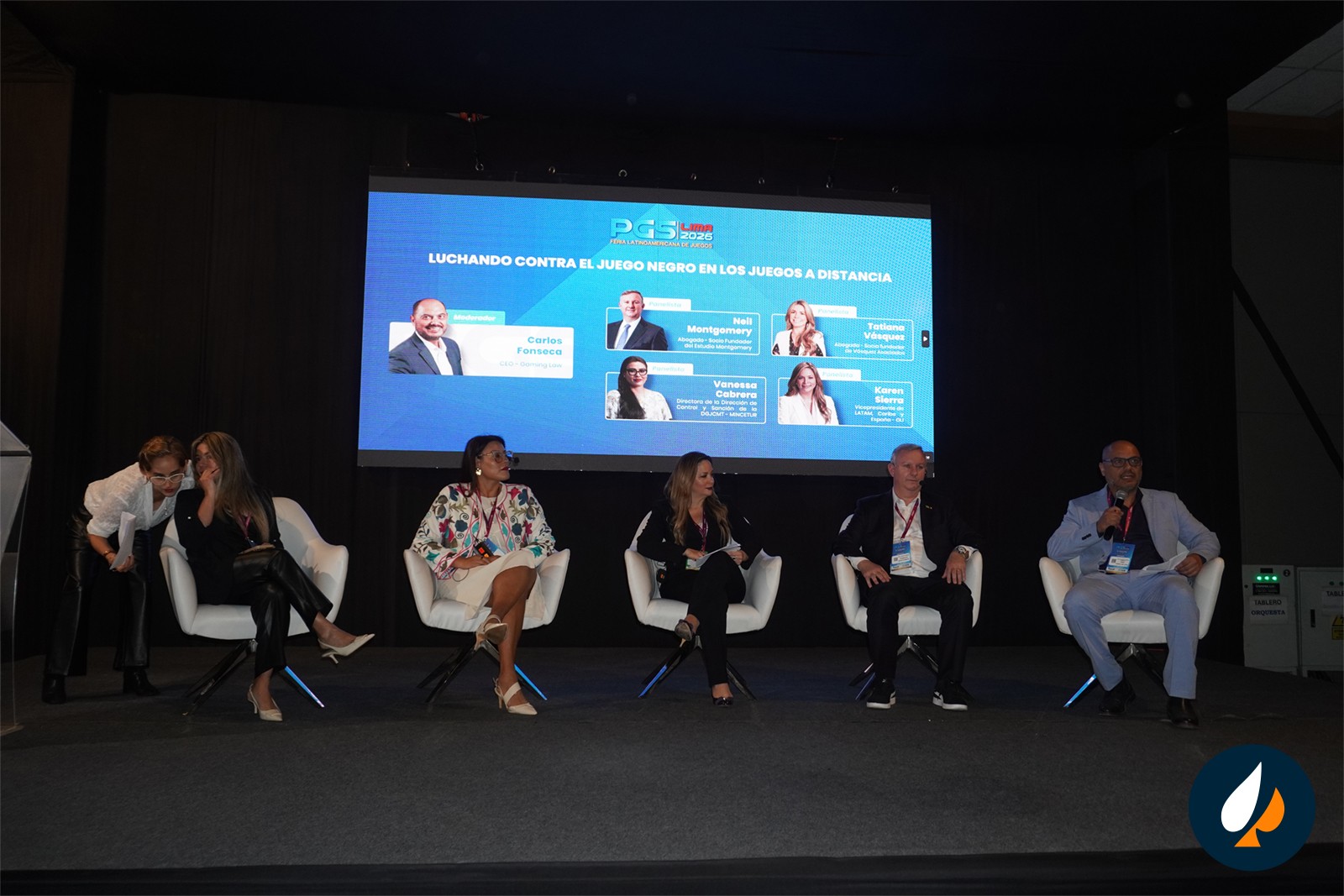
Why is the Online Gambling Black Market Growing?
Carlos Fonseca opened the debate by pointing out that taxation and regulation can become drivers for informality when they are not reasonable.
"Bad taxation can generate exactly the issue we are going to discuss now: the black market."
With that introduction, he invited the panelists to analyze the main causes of illegal gambling growth in Latin America and other regulated markets.
The Impact of the Tax Burden
The first to respond was Neil Montgomery, who explained that in Brazil, the main incentive to operate outside the regulated system is financial.
"Illegal gambling does not pay taxes... foreign operators who have not obtained a license in Brazil do not pay taxes either, and that means the 'odds' can be better because they don't face the costs that licensed operators do."
Montgomery added that regulatory demands—such as facial recognition processes, KYC measures, and the high cost of federal licenses—also favor the persistence of illegal operators.
Regulations Adapted to Each Market
On her part, Karen Sierra Hughes argued that overly restrictive regulation can end up strengthening the illegal market.
"The more that is included within what is legal and regulated, the more opportunities there are to leave the illegal market without options."
She also highlighted the importance of adapting rules to the reality of each jurisdiction in Latin America and warned that excessive restrictions on advertising benefit those operating outside the regulated system.
From the perspective of the Peruvian regulator, Vanessa Cabrera identified three key factors: the advertising of illegal platforms, regulatory asymmetries between countries, and the enforcement capacity of each authority.
"We have to look at what capacity we have to sanction, to supervise, and what execution capacity we have to face the issue of illegal operations."
In her turn, Tatiana Vásquez remarked that many consumers still do not distinguish between legal and illegal operators.
"Many times, users do not distinguish between a legal and an illegal operator and do not realize the risks of betting on a platform that does not have any type of control and regulation."
Competitive Regulation and Control of the Entire Value Chain
The specialists agreed that combating the black market in Latin America requires a comprehensive strategy.
Regulation that Favors Channeling
Tatiana Vásquez maintained that the priority must be a competitive regulation that allows channeling demand toward authorized operators.
"If the regulation is competitive, it is undoubtedly a very effective tool to achieve real channeling."
She also proposed strengthening controls over payment methods and involving all actors in the ecosystem—technology providers, laboratories, affiliates, and payment processors—under a model of co-responsibility.
The Peruvian Experience
Vanessa Cabrera explained that Peru has focused its efforts on reducing illegal supply by supervising content providers and payment gateways.
According to her, these actions have caused numerous informal operators to migrate to the regulated market upon losing competitiveness.
Penalizing Illegal Gambling and Strengthening Institutions
The Debate on Criminalization
Karen Sierra Hughes defended the need for illegal operations to be considered a crime.
"I believe one of the main points is to classify illegal gambling as a felony, as a crime, and with prison sentences."
She also stressed the importance of specializing prosecutors, judges, and security forces so they understand how the industry works, and even proposed debating the responsibility of players who deliberately participate in illegal platforms.
Neil Montgomery commented that Brazil already contemplates penalties for those participating in illegal games and highlighted two especially effective measures: controlling international financial flows and making it easy for users to identify authorized operators through the ".bet.br" domain.
"It is a very interesting way to educate Brazilian players to identify which houses are authorized."
Brazil: A Market with Still High Informality
Between 30% and 40% of the Market
When analyzing the Brazilian case, Montgomery pointed out that the most recent estimates place the illegal market between 30% and 40% of the total.
He explained that, although there are currently 85 operators with federal licenses and multiple state licenses, high regulatory and tax costs still represent a barrier to entry for new legal operators.
The Role of Tech Providers and Payment Methods
Reducing Illegal Supply
Vanessa Cabrera explained that the Peruvian strategy is not limited to chasing illegal operators but also targets those who integrate the entire technological chain.
The official indicated that registered providers have the obligation not to provide services to platforms without authorization and that, in case of non-compliance, they can lose their authorization to operate.
Additionally, she announced that MINCETUR is working alongside the Ministry of Transport and Communications on blocking approximately one hundred illegal platforms through DNS mechanisms to hinder their access from Peru.
Technological Tools to Block Illegal Gambling
Geolocation and Payment Blocking
Karen Sierra Hughes reviewed various tools used internationally to limit illegal activity, including geolocation, geofencing, and domain and IP blocking.
She also highlighted initiatives developed in Argentina to prevent minors from accessing illegal sites and explained that regulators are increasing cooperation with internet service providers and payment companies.
"If you cut off the payment method, it is the best way to attack illegal operators."
Furthermore, she noted that several regulators are already holding direct talks with companies like Visa and Mastercard to restrict transactions linked to illegal operators.
Criminalization and International Cooperation
A Shared Challenge in Latin America
In the final part of the debate, Tatiana Vásquez recalled that in Colombia, the illegal operation of games of chance is already a crime punished with prison sentences, although she acknowledged that the biggest challenge remains the criminal prosecution of cross-border activities.
For this reason, she insisted that investigations must cover the entire value chain and not just the operators.
"The active subject of the conduct is not only the one who operates. Here we also have the platform provider, the game provider, the payment method, and the advertising media."
In closing the conference, Carlos Fonseca summarized the consensus reached among the participants:
"The option is not to ban betting games; the option is to regulate them, but to regulate them rationally so that it does not lead to the promotion of clandestine games and black-market gambling."
Categoría:Events
Tags: PGS, Peru Gaming Show,
País: Peru
Región: South America




Event










SBC Summit 2026
29 de September 2026
Ready Play Gaming Highlights New Opportunities After SBC Summit 2026
Tuesday 13 Oct 2026 / 12:00
Uplatform Brought "Your Dreams. Our Platform" to Life at SBC Summit Lisbon 2026
Friday 09 Oct 2026 / 12:00
Kambi Highlights Network and LatAm Growth at SBC Summit
Friday 09 Oct 2026 / 12:00
SUSCRIBIRSE
Para suscribirse a nuestro newsletter, complete sus datos
Reciba todo el contenido más reciente en su correo electrónico varias veces al mes.