ADCJ Calls for Modernized Casino Regulation in the Dominican Republic
Monday 10 de August 2026 / 12:00
⏱ 6 min read
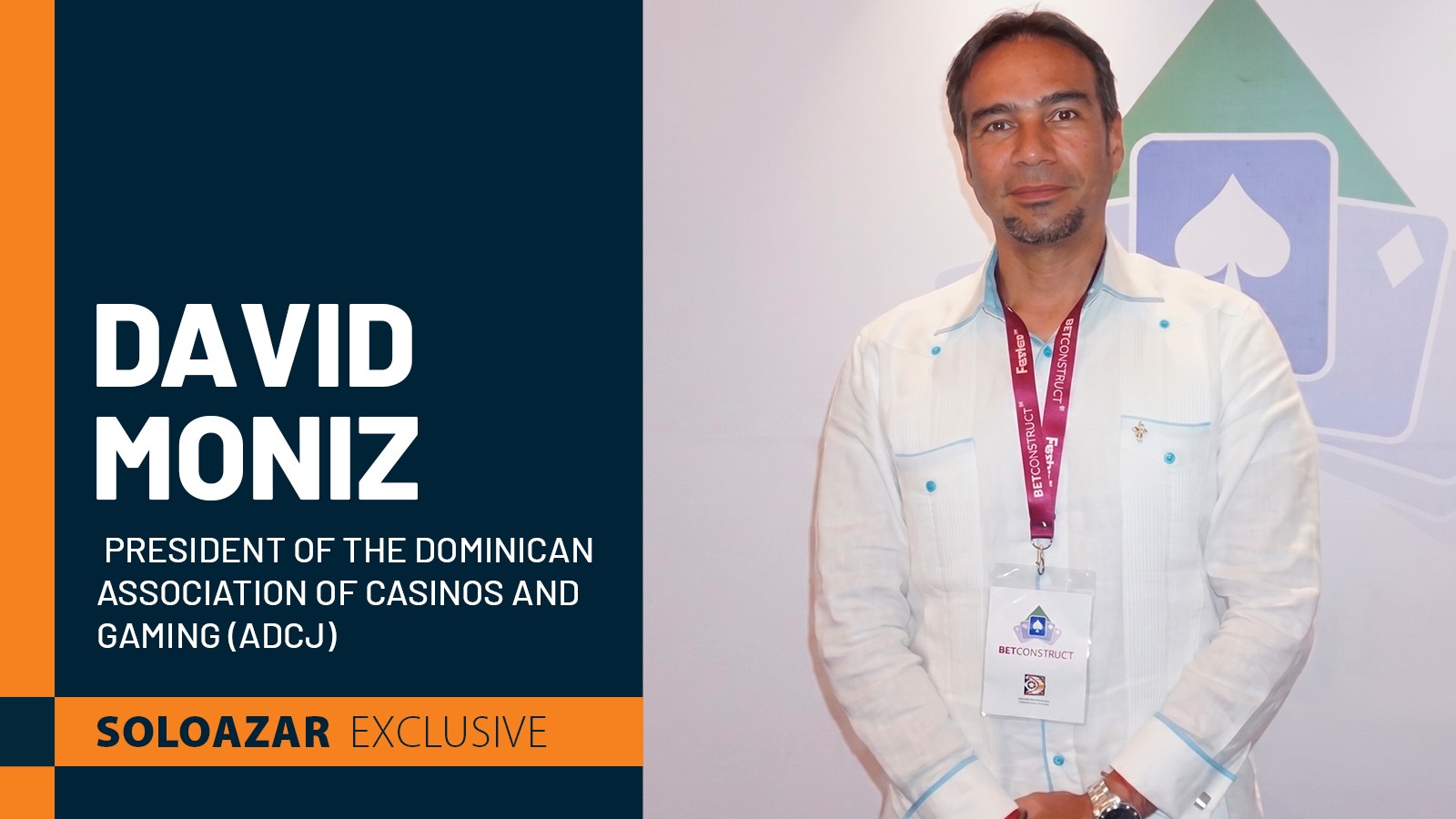
(Santo Domingo, SoloAzar Exclusive).— Amid ongoing debates over the Dominican Republic's new Gambling Bill, David Moniz, President of the Dominican Association of Gaming Casinos (ADCJ), examines the proposed regulatory changes and outlines his priorities for their implementation. The ADCJ views this reform as a vital opportunity to modernize industry oversight, encourage formalization, ensure legal certainty, and align the nation's casino and gambling sector with global standards.
A reform to strengthen gaming supervision
The ADCJ maintains that the casino industry constitutes one of the relevant components of the Dominican tourism offering, as it is mainly integrated into hotel complexes and contributes to formal employment generation, investment, and economic activity.
Over the last few decades, the sector has also incorporated international compliance standards, internal controls, anti-money laundering prevention, independent audits, and corporate governance structures. In this context, the association participates in the debate on the new bill with the aim of contributing to the construction of a regulatory framework in line with the technological and commercial evolution of the market.
The project contemplates the creation of a General Directorate of Gaming as a regulatory body, as well as a licensing regime and greater controls over land-based and digital operations.
Independence and effective supervision capacity
When asked about the changes the ADCJ expects with the implementation of this new scheme, David Moniz pointed out:
"The creation of a specialized authority represents an opportunity to strengthen the institutionality of the sector, provided it has technical independence, clear rules, and effective supervisory capacity. At the Dominican Association of Gaming Casinos, we understand that the success of any regulatory body will not solely depend on new legal powers, but on the uniform application of regulations, the transparency of its actions, and the legal certainty it offers to all operators."
"We expect a supervision model based on technical criteria, with modern licensing, inspection, and control processes that allow reducing informality, guaranteeing fair competition conditions, and protecting both the consumer and responsible investment. Efficient regulation should facilitate compliance, not turn it into a disproportionate burden."
For the ADCJ, the modernization of the legal framework should aim to strengthen the effective compliance of rules through a modern, proportional, and technically consistent regulatory system. The goal is for the regulation to incentivize formalization and allow improving the State's supervisory capacity without generating conditions that favor the displacement of operations towards informality.
The discussion on casino licenses
One of the aspects generating the most debate within the bill is the ten-year moratorium on new licenses for certain establishments, although exceptions are contemplated for casinos located in hotels and tourist areas.
The ADCJ also questions the proposal to separate the licenses corresponding to table games and slot machines, considering that both activities are part of an integral casino operation. In its view, this fragmentation could introduce operational complexities and legal uncertainty in an activity that requires clear and predictable rules to continue attracting investments.
The proposal for a 15-year license
Regarding the moratorium and the duration of the licenses, Moniz explained:
"We have continued debating this point; it originally contemplated 5 years and has already been increased to 10 years. Due to criteria of regulatory proportionality, legal certainty, and international standards of the casino-tourism industry—where long-term authorizations are the norm—we continue to insist that the casino license must have a duration of no less than fifteen (15) years, renewable for equal periods, without this affecting the State's police power, which fully retains its powers of supervision, sanction, suspension, and revocation."
The association considers that regulatory predictability is especially relevant for an activity linked to tourism and long-term investments. In this sense, it defends that the new legislation be based on principles of reasonableness, proportionality, legal certainty, and regulatory equality.
Informality and unfair competition, among the market challenges
Another central axis of the regulatory debate is the growth of certain betting points and the need to reinforce inspection mechanisms to avoid situations of unfair competition.
For the ADCJ, the challenge is not only about incorporating new restrictions but about guaranteeing an effective and uniform application of existing rules.
Effective compliance with regulations
When asked about the main challenges of ordering and inspecting the Dominican market, the president of the association replied:
"The main challenge for the Dominican market is not the lack of regulation, but the need to achieve effective and uniform compliance with existing rules. For years, there has been unequal growth between different gambling subsectors, generating spaces where informality and unfair competition affect those who operate within the legal framework."
"International experience shows that when rules are modern, proportional, and applied consistently, formalization increases and the State's collection capacity improves. On the other hand, when there are regulatory burdens unaligned with the market reality or unequal supervision, incentives are created that favor the permanence of operators outside the system."
From the ADCJ's perspective, outdated legislation in the face of market evolution and unequal application of current provisions can generate spaces of informality, unfair competition, and regulatory distortions that end up affecting both the State and the operators who fulfill their obligations.
Taxation and international standards
In addition to licenses and supervision mechanisms, the ADCJ considers it necessary to review certain technical aspects of the bill before its final approval.
One of them is the definition of the tax base. The association points out that the bill adopts the GGR criterion for certain modalities, such as online gaming, while establishing a different methodology for other activities, calculating the tax on the total amount wagered without deducting prizes.
For the ADCJ, this difference could generate contradictory interpretations, administrative difficulties, and tax distortions, which is why it considers it advisable to review the criterion before the definitive approval of the legislation.
The association also questions the time restrictions exclusively applicable to casinos. Its position is that these establishments are part of the permanent entertainment offering of hotel complexes and cater to an international tourist demand that does not necessarily adjust to traditional commercial hours.
Priorities for a new regulatory stage
If the new law is definitively approved, the challenge will be to determine how to implement the new system without affecting the sustainability of formal operations and, at the same time, raising the standards of control, user protection, and responsible gaming.
Legal certainty, supervision, and responsible gaming
Regarding the priorities that the State and operators should assume, Moniz stated:
"The approval of a new law must mark the beginning of a new stage for the industry, based on four fundamental priorities: first, to guarantee legal certainty and regulatory stability; second, to strengthen supervision with technical and homogeneous criteria for all operators; third, to promote formalization through a modern, proportional, and competitive regulatory framework; and fourth, to consolidate standards for user protection, anti-money laundering prevention, and responsible gaming."
"The Dominican Association of Gaming Casinos is convinced that the best regulation is one that manages to balance the public interest with economic development, encourages voluntary compliance, and creates the conditions for the sector to continue contributing to tourism, formal employment, and public finances."
For the ADCJ, the objective of the new legislation should not be limited to increasing controls, but building a system that promotes voluntary compliance, incentivizes formal investment, strengthens state supervision, and raises transparency standards for all market participants.
An opportunity for the Dominican market
The debate on the new Gambling Law opens a defining stage for the future of the Dominican industry. For the ADCJ, the modernization of the regulatory framework should allow the State to strengthen its supervisory tools without generating disproportionate burdens that could favor informality.
The association also highlights the compliance trajectory of Dominican casinos and their contribution to tourism, formal employment, and the national economy. In this sense, it considers that the reform can become an opportunity to consolidate a regulatory model capable of combining consumer protection, fair competition, legal certainty, and investment.
In a market undergoing transformation, the discussion on the new legislation will be decisive not only to define the operating conditions of casinos and other gaming segments, but also to establish the balance between state control, economic development, and the competitiveness of the Dominican Republic as an international tourist destination.
Categoría:Exclusive
Tags: Sin tags
País: Dominican Republic
Región: Central America and Caribbean




Event









SiGMA North America 2026
01 de September 2026
"Technology can be global, but execution in LATAM must be local": Borut Leban on Timeless Tech's Regional Expansion
(Mexico City, SoloAzar Exclusive).- Following a highly successful showing and a 'Best Aggregator 2026' award at SiGMA North America, Timeless Tech CEO Borut Leban reflects on the company's strategic growth across LatAm. In this interview, Leban discusses the necessity of deep market localization, concrete new business opportunities, and the upcoming launch of their unified retention ecosystem, Timeless Arena.
Friday 18 Sep 2026 / 12:00
BSW Highlights Validation and Growth Opportunities in the LATAM iGaming Market
(Mexico City, SoloAzar Exclusive).- In Q&A with SoloAzar, Betting Software (BSW) Head of Digital Marketing Ilia Chumak discussed the company's standout showcase in SIGMA North America. Highlighting the incredible energy of the region, Chumak noted that the event was a major success for BSW, resulting in active negotiations and verifying multiple deals straight from their booth.
Friday 18 Sep 2026 / 12:00
SiGMA North America Explores Affiliate Marketing After Sports Events
(Mexico City, SoloAzar Exclusive).- At SiGMA North America 2026, Fernanda Figueroa, Affiliate Manager at 1win Partners, examined how affiliates can monetize sports events in LATAM beyond the initial traffic spike. During the conference “Beyond the Spike: How Affiliates Monetize Sports Events in LATAM All Year Round,” she discussed sports betting traffic, player retention, campaign localization and audience segmentation as key elements for extending the value of major sporting events.
Friday 18 Sep 2026 / 12:00
SUSCRIBIRSE
Para suscribirse a nuestro newsletter, complete sus datos
Reciba todo el contenido más reciente en su correo electrónico varias veces al mes.