U.S. Online Sports Betting 2024: map of Taxes by State
Thursday 19 de September 2024 / 12:00
⏱ 2 min read
(Columbia).-Legal sports betting has grown rapidly since the Supreme Court granted states the ability to establish online sports betting markets in Murphy vs. NCAA in 2018
Legal sports betting has grown rapidly since the Supreme Court granted states the ability to establish online sports betting markets in Murphy vs. NCAA in 2018. Pre-Murphy, consumers could only bet legally in a handful of states, but today, 38 states and Columbia allow sports betting in some form.
However, sports betting markets vary substantially across states that have legal betting markets. Notably, states apply a range of different tax rates (sometimes differentiating between online wagers and brick-and-mortar wagers), and access to legal sports betting can be quite limited.
Consumer access to legal betting markets is limited primarily by high barriers to entry for sports betting operators who wish to offer services in the state and by limits on the geographic locations at which players are allowed to place bets.
Common barriers facing operators include expensive licensing fees and requirements for online sportsbooks to partner with existing in-state brick-and-mortar operators. In Massachusetts, for example, sportsbooks must pay an initial fee of $5 million, with another $5 million renewal fee every five years. Sportsbooks in Pennsylvania are required to pay a one-time fee of $10 million and a $250,000 renewal fee every five years.
New jersey requires online sportsbook operators to partner with a licensed brick-and-mortar racetrack or casino in the state, while Ohio offers online sportsbooks the option to partner with a professional sports organization approved by the Casino Control Commission to offer mobile sports wagering.
Other states mandate a partnership with the state lottery commission or hand control of online sports betting markets to the state lottery commission. In Connecticut, online gaming operators wishing to offer services in the state must partner with a state-approved master gaming operator. Montana monopolized all sports betting under the Montana Lottery Commission.
Several states also restrict where players can gamble online. In Delaware, Mississippi, Montana, New Mexico, North Dakota, South Dakota, Washington, and Wisconsin, would-be gamblers can only place bets at select locations such as retail casinos, state-operated facilities, or tribal lands.
In other states, online wagers are treated differently from wagers placed in person. In Kentucky, Louisiana, Massachusetts, New Jersey, and New York, online wagers are taxed more heavily than retail (in-person) wagers.
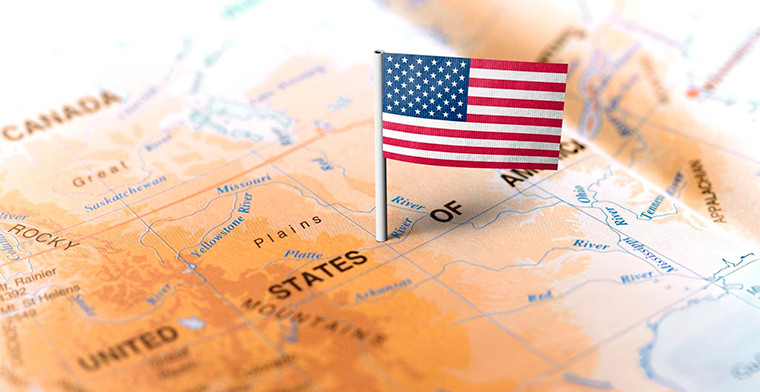
While 38 states have legalized sports wagering in some capacity, bettors only have statewide access to online sports betting platforms in 27 states and the District of Columbia. New Hampshire, New York, and Rhode Island apply the highest tax rate to sportsbooks at 51 percent. Nevada and Iowa apply the lowest tax rates at 6.75 percent. Today’s map shows the distribution of online sports betting tax rates across US states.
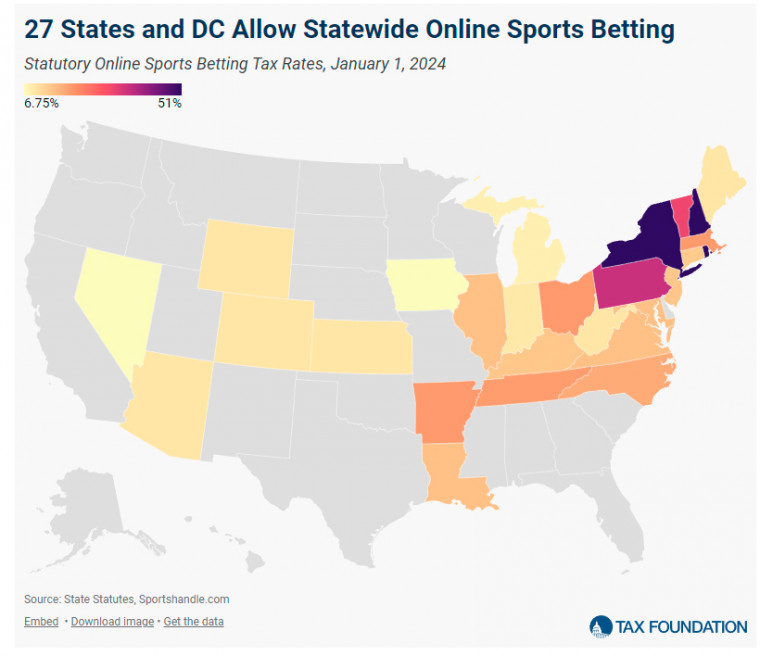
The market for sports betting will likely continue to grow substantially. Texas and California don’t yet permit legal sports wagering markets. With nationwide legalization, sports betting market volume could easily double.
As the tax base grows, tax policy design becomes increasingly important. Rates should be low enough to pull participants out of black markets and into the legal, regulated markets.
Categoría:Legislation
Tags: Sin tags
País: United States
Región: North America




Event









SiGMA North America 2026
01 de September 2026
LatAm Regulators Discussed Illegal Gambling and Innovation at SiGMA North America
(Mexico City, SoloAzar Exclusive).- The panel "The Red Pen Forum: Regulators Respond to the Industry," held during SiGMA North America 2026, brought together representatives from Uruguay, Argentina, Puerto Rico, and Honduras to analyze regulatory challenges, digital transformation, illegal gambling, and the need to adapt lotteries for new generations. The conference was moderated by Rodrigo Cigliutti, Executive Director of CIBELAE (Ibero-American Corporation of State Lotteries and Betting), and featured the participation of Marcelo Visconti, National Director of Lotteries and Quinielas of Uruguay; Carlos Moyano, President of IAFAS Entre Ríos, Argentina; Heidi Hernández Olivo, Deputy Secretary of the Puerto Rico Lottery; and Lissa Mencía, General Director of Lottery Operations and Games at Loto Honduras.
Monday 28 Sep 2026 / 12:00
SiGMA North America Addressed Crisis Management in iGaming
(Mexico, SoloAzar Exclusive).- During SiGMA North America 2026, Rosa Ochoa, founder of the Blue Global Gaming platform and strategic advisor for gaming operators; Iliana María Pineda Echeverri, Chief Legal & Compliance Officer at Wplay.co; Iraid Rosales, Country Manager Mexico at Amusnet; and Elizabeth Maya Cano, Executive President of CORNAZAR, analyzed the key factors in managing crisis situations within the iGaming industry, with a special focus on transparency, communication, technology, and preparation.
Friday 25 Sep 2026 / 12:00
Affiliates and Acquisition: Keys to Regulated Markets in North America
(Mexico City, SoloAzar Exclusive).- During SiGMA North America 2026, Cristopher Guzmán Reyes, Head of Affiliates at Logrand Entertainment Group; Guga Júnior, influencer and slots expert at Scalar Partners; Andrés Gómez, Head of Latin America Go-to-Market Strategy at Admattic; Yambot Aguilera, Gaming and Finance Sales Director at Google; and Paula Gabriel Jiménez, Advertising Client Growth Director for Microsoft at Aleph, analyzed the state and provincial affiliate ecosystem in North America, as well as the acquisition challenges in regulated markets.
Thursday 24 Sep 2026 / 12:00
SUSCRIBIRSE
Para suscribirse a nuestro newsletter, complete sus datos
Reciba todo el contenido más reciente en su correo electrónico varias veces al mes.